The Culture Behind the Service – Why Human-Centered Leadership Matters for HOA Communities
Most HOA boards do not think about the culture of the accounting firm they hire. They think about price, responsiveness, and whether the reports arrive on time. Those things matter. But after years of working with communities across the country, I have come to believe that culture is the reason those things happen or do not happen. It is not separate from the service. It is the source of it.
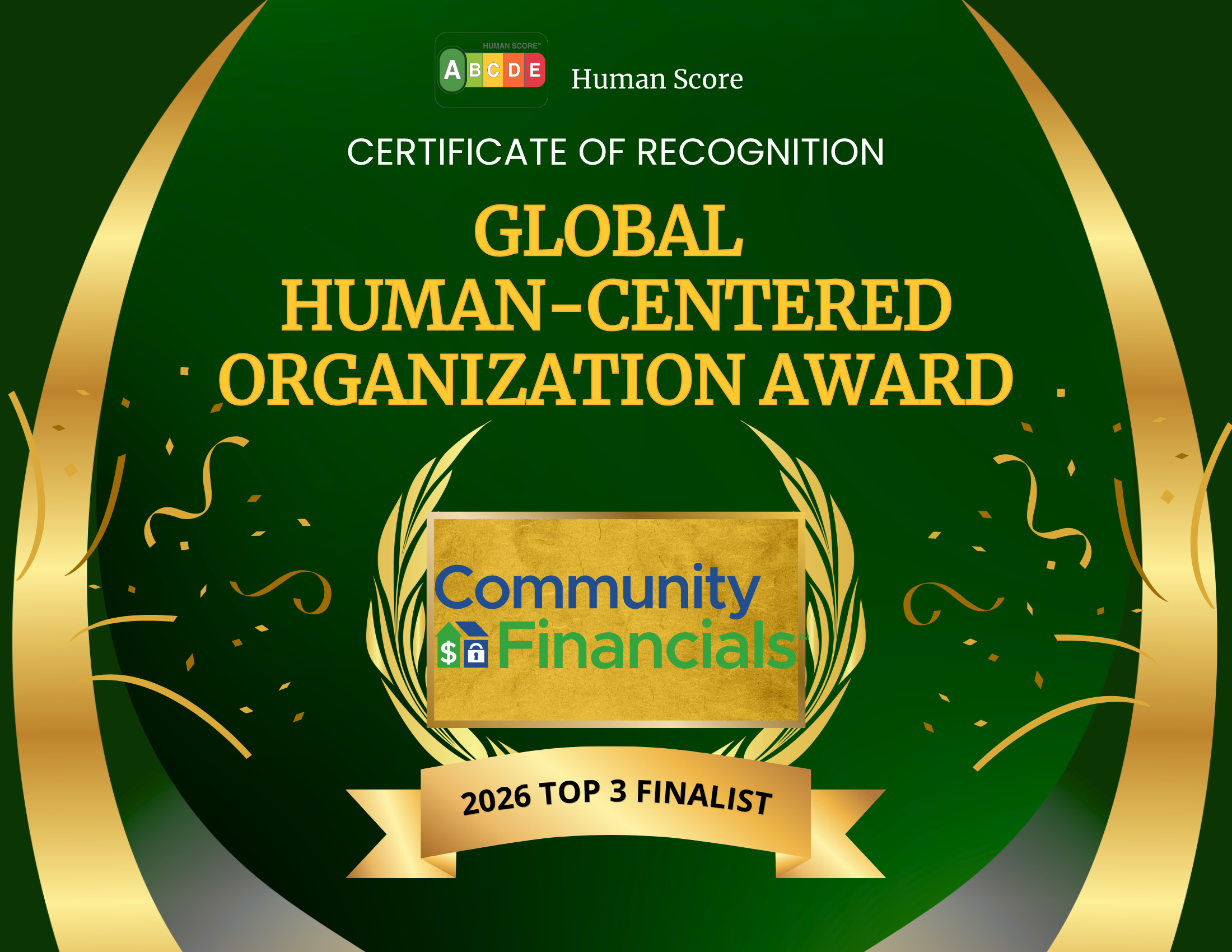
Karen Ziegler at the Human Score recently asked me to sit down and talk about how we run Community Financials. It was part of our recognition as a 2026 Global Human-Centered Organization Award Finalist – an award that recognizes companies that put people at the heart of how work is designed, decisions are made, and value is created. What made the conversation worth having was not the recognition itself. It was the chance to talk openly about the choices behind it.
Where This Started
I started Community Financials in 2018 after watching a competitor steal over two million dollars from HOA communities they were hired to serve. The boards had trusted them completely and the money was gone. That experience left a lasting impression on me, not just because of the fraud itself, but because of what it revealed about what was missing. There was no real transparency, no meaningful oversight, and underneath all of that, a culture where doing right by the people you serve was not actually the priority.
I wanted to build something different. A service that would provide the financial oversight, reporting, and monthly accounting that communities deserved, but more than that, a team that actually cared about the people on the other end of every report.
What The Army Taught Me About Leadership
Before I started Community Financials I spent five years as an Army officer, working my way up from lieutenant to captain. I call it my real-world MBA because you learn just as much from poor leaders as you do from exceptional ones.
One of the ideas that stayed with me was the concept of the soldier’s soldier – a leader who looks out for the troops first, provides training and resources, and puts themselves last. In the military there is a practice of leaders eating last, standing at the end of the line to make sure the soldiers are fed before serving yourself. It sounds simple but it is purposeful. It demonstrates clearly where you stand relative to the people you lead, and it sets the tone for everything else.
I carry that into how I run Community Financials. A leader who only thinks about themselves creates a team that only thinks about themselves. A leader who genuinely looks out for the people they manage creates a team that extends that same care outward to the customers they serve.
The other concept I rely on is Commander’s Intent – sharing the vision clearly enough that when I am not in the room, the team knows what the objectives are and can make good decisions on their own. In a growing service business this matters enormously. When people understand the direction and the values behind it, they can act with confidence and consistency without needing to check in constantly. We are all rowing the boat in the same direction.
It’s Humans Serving Humans
When Karen asked me what human-centered leadership looks like in a concrete, lived way, I said something I genuinely believe.
It is humans serving humans.
Behind every financial report is a board trying to make the right decision for its community. Behind every account is a group of homeowners trusting that their money is being handled properly. And behind the service we provide is a team of people who need to feel trained, supported, and trusted to do their best work.
Those three things are connected in ways that are hard to overstate. You cannot deliver consistently great service from a team that does not feel valued, and you cannot build a team that feels valued without making specific, deliberate choices about how you operate every day.
The Choices That Shape The Service
A lot of companies write their values on the wall and that is the last you see of them. At Community Financials our four core values are delivering a wow experience, keeping our promises, continual improvement, and listening, solving problems, and educating. Here is what living those values actually looks like.
- Quarterly performance reviews tied to core values. Each evaluation includes a self-assessment and a supervisor assessment on the values specifically — because the conversation should not only be about what someone produced but about who they are being in the process of producing it. That happens four times a year because people need the opportunity to self-correct throughout the year, not just once in December.
- Monthly anonymous staff surveys. The team can tell us what they want to see changed. We rank-order the results at our annual strategy session and make changes accordingly. It means the people closest to the work are shaping how the work gets done.
- Video calls over email. Email is tone deaf in ways that are easy to underestimate. Getting on a video call, sharing a screen, and walking through financial information together is a better experience for the board and more satisfying for the team member delivering it.
- Willingness to let a customer go. When the relationship is making it impossible for the team to do good work, we end it. It is harder for me to find an excellent person with the right character than it is to find another customer. Protecting the team is protecting the service.
- Public recognition for living the values. In our quarterly all-hands meetings I take online reviews and emails where someone praised a team member and give public shoutouts. It makes the values feel lived rather than aspirational.
What This Means For The Communities We Serve
None of these are soft decisions. They are business decisions that show up directly in the service we deliver. When team members feel heard and supported they answer questions the same day. When they are not worn down by difficult interactions they bring patience and care to every board they work with. And when they stay long enough to know the communities they serve, that continuity replaces the constant relearning that comes with high turnover.
I have had team members tell me they are experiencing something different here than anywhere else they have worked. That experience flows directly into how they show up for boards and homeowners every single day.
As I said to Karen at the end of our conversation — it is worth the investment. You create a stable business because you have staff who want to stay longer and customers who want to stay longer. And as a leader you can look at yourself in the mirror and know you are doing something of real value.
Watch the full conversation here
If you want to talk about what that service looks like for your community, we are glad to have that conversation. Schedule a call or call 833-CONDO-HOA.