
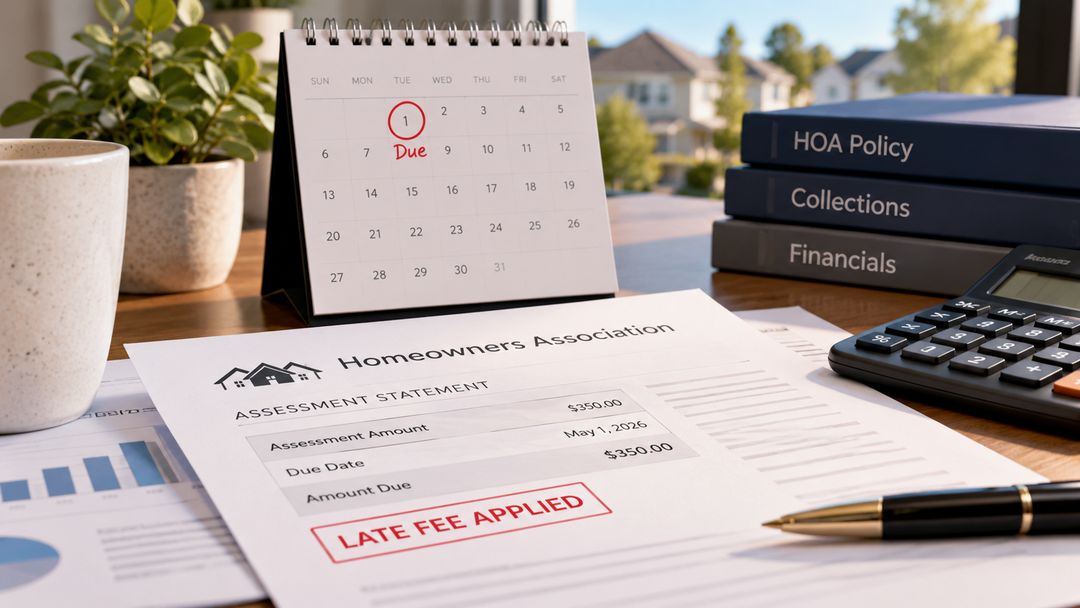
HOA Late Fees Should Be a Process, Not a Punishment
Nobody joins an HOA board because they want to charge their neighbors late fees.
Yet assessments have to be collected. The association still has insurance premiums, vendor contracts, utilities, maintenance costs, reserve contributions, and other obligations to pay whether every homeowner pays on time or not. When assessments arrive late, somebody has to address the problem.
That is where HOA late fees are supposed to help. They create a clear consequence for missing a payment deadline and encourage owners to keep their accounts current. Problems begin when the late fee becomes personal.
Some communities avoid enforcing late fees altogether because the process can feel difficult to administer consistently, especially when board volunteers are already short on time. But inconsistent or selective enforcement can create even more confusion for homeowners and make the association’s policies harder to defend if a dispute escalates.
One owner receives a reminder before being charged. Another is charged immediately. Someone who knows a board member gets extra time. A payment arrives before the deadline but is not posted until afterward. A homeowner disputes a charge, and nobody can easily reconstruct what happened.
At that point, the problem is no longer simply that an assessment was late. The association has a financial process that owners and board members may have trouble trusting.
A better approach treats HOA late fees as one step in a consistent accounts receivable process. The goal is to collect the money the community needs while keeping the board out of unnecessary disputes and treating owner accounts as accurately and consistently as possible.
The goal is simple: collect the funds the association is owed so it can meet its budgeted obligations. Higher delinquency can put pressure on the rest of the community, potentially leading to higher dues or special assessments to cover shortfalls. It can also make borrowing more difficult if delinquency levels become too high. And because collection deadlines and statutes of limitation vary by state, allowing unpaid assessments to sit unresolved for too long can make recovery more difficult or, in some cases, impossible. For a nonprofit association operating on a fixed budget, having a consistent process for collecting what is owed is essential.
In This Article
- What HOA late fees are supposed to accomplish
- Why consistency matters
- Why payment processing has to come first
- The role of courtesy reminders
- What a reliable late fee process looks like
- Why boards should avoid case-by-case collection decisions
- How late fees affect financial reporting
- How professional accounting support can help
- Frequently asked questions about HOA late fees
HOA Late Fees Have a Financial Purpose
A late fee should have a fairly straightforward purpose.
The association establishes an assessment due date. Owners know when payment is expected, and the association relies on those assessments to fund its operations. If payment is not received according to the association’s governing documents, collection policy, and applicable law, the account moves into the next stage of the established process.
The fee provides an incentive to pay on time while helping address the administrative burden associated with delinquent accounts. What it should not become is a way for the board to express frustration with a particular owner.
Late fees work best when they are predictable. Owners should be able to understand when an assessment is due, whether a grace period applies, when a late fee may be charged, and what happens if the balance continues to remain unpaid.
The board should be able to explain the same process just as easily.
Inconsistent HOA Late Fees Create Avoidable Disputes
Few things make an accounting issue feel personal faster than inconsistent treatment.
Imagine two owners both miss the same assessment deadline. One contacts a board member and receives another week to pay without penalty. The other does not know anyone on the board and receives a late fee.
Even if everyone involved meant well, the association now has a difficult question to answer: why did the same situation produce two different results?
Informal exceptions can also become harder to manage as the board changes. A longstanding director may remember that a particular homeowner is normally given additional time. A new treasurer may have no idea that arrangement ever existed.
The cleaner approach is to establish a documented process and follow it consistently, subject to any exceptions that the governing documents, applicable law, or association counsel determine are appropriate.
Consistency protects owners, but it also protects the board. Directors no longer have to decide from scratch how aggressively to respond every time somebody pays late, and homeowners are less likely to feel they are being treated differently from their neighbors. Inconsistent treatment can also lead to disputes and, in some cases, legal challenges, which is why the same principle should apply throughout the entire collection process.
Before Charging a Late Fee, Make Sure the Payment Is Actually Late
This sounds obvious. In practice, accurate payment processing is one of the most important parts of the process.
Suppose an owner submits a payment on time, but the payment is not entered into the accounting system promptly. If the system subsequently assesses a late fee based on an outdated balance, the association has created an owner-account problem that did not need to exist.
The same thing can happen when payments are applied to the wrong unit, recorded for an incorrect amount, left unapplied, or allocated incorrectly among assessments and other charges.
That is why HOA late fees cannot really be separated from the quality of the underlying accounting.
Before an automated or manual collection process moves an account forward, the association needs confidence that its homeowner ledgers are current and that recent payments have been handled correctly.
Otherwise, the board may find itself trying to enforce a charge that originated with its own bookkeeping error.
A Courtesy Reminder Can Solve the Problem Before It Becomes a Collection Issue
Not every late assessment represents a serious collection problem.
An owner may have changed banks and forgotten to update an automatic payment. A mailed payment may have been delayed. Someone may have overlooked a statement during a move or vacation. Another homeowner may genuinely be experiencing financial difficulty.
The accounting records do not need to speculate about the reason. They simply need to show accurately whether the amount is due.
From there, an established courtesy reminder can give the owner an opportunity to address the balance before the account moves further into the collections process.
That distinction is useful because escalation should be deliberate. If a simple reminder resolves the issue, the association receives its assessment and avoids turning a minor oversight into weeks of correspondence.
If the balance remains unpaid, the board also has a documented record showing that the association followed its established process.
What a Reliable HOA Late Fee Process Looks Like
The exact timeline will vary by association and jurisdiction, but the underlying structure should be easy to follow.
| Stage | What should happen |
| Assessment becomes due | The owner account reflects the correct charge and due date |
| Payment period | Incoming payments are recorded promptly and accurately |
| Grace period, if applicable | The account remains monitored according to the association’s policy |
| Payment becomes late | Any permitted HOA late fees are applied consistently |
| Courtesy communication | The owner receives appropriate notice of the outstanding balance |
| Continued delinquency | The account appears clearly in delinquency reporting |
| Additional collection steps | The association follows its adopted collection policy and obtains legal guidance when required |
| Payment received | The owner ledger is updated so the board can see the current balance |
| Owner reminder or statement | The owner receives a reminder by email or mailed statement showing the amount due and payment deadline |
The value of this structure is not complexity. It is predictability.
The board knows what happens next. The owner knows what happens next. The accounting records document what happened previously.
That is much easier to manage than a collection system built around individual emails, memory, and board-by-board judgment calls.
The Board Should Not Have to Personally Chase Every Late Payment
This is one of the uncomfortable parts of self-managed HOA finances.
The treasurer opens the aging report and recognizes every name.
Someone has to send the reminder. Someone has to follow up when there is no response. And someone has to explain why a fee was charged. Eventually, the financial problem can turn into a relationship problem between neighbors.
A structured accounts receivable process creates some healthy distance.
The board still establishes policies and retains appropriate oversight. It can review delinquency reports, understand how much money is outstanding, and make decisions when an account requires additional action.
But directors do not necessarily need to become the people repeatedly emailing a neighbor about a past-due balance.
That is an important distinction for volunteer boards. Financial oversight belongs with the association. Routine accounting administration can be handled through a system designed to apply the board’s decisions consistently.
Be Careful About Waiving Late Fees Informally
There may be situations in which a late fee can or should be waived. The answer will depend on the association’s governing documents, applicable law, adopted policies, and the circumstances involved.
The important issue for boards is how those decisions are made.
A director should be cautious about casually telling an owner, “Don’t worry about it, we’ll remove the fee,” without understanding whether they have authority to make that decision or how similar requests have been handled.
Frequent informal waivers can also undermine the purpose of the policy. If owners learn that a late fee disappears whenever someone complains, the stated collection process and the actual collection process are no longer the same.
If the association allows waivers under defined circumstances, those circumstances should be documented and applied consistently.
Boards facing unusual situations should consult qualified association counsel rather than improvising legal or collection rules themselves.
Late Fees Do Not Fix a Growing Delinquency Problem
A $25 or $50 fee does not replace an unpaid assessment.
If an owner falls several months behind, repeatedly adding charges to the ledger may increase the balance without improving the association’s cash position.
That matters because HOAs operate on actual cash.
Insurance companies, landscapers, utility providers, repair contractors, and other vendors are not paid with accounts receivable. The association needs collected funds in the bank.
Boards should therefore look beyond the total amount of HOA late fees being charged and pay attention to the underlying delinquency trend.
Questions worth asking include:
- How many owners currently have past-due balances?
- Are most delinquencies recent, or are balances aging for several months?
- Is the total amount outstanding increasing?
- Are payments and late fees being recorded consistently?
- Are owners receiving required notices on schedule?
- Are any accounts remaining in the same stage of the process for too long?
- Is the association’s collection policy actually being followed?
A late fee can support the collection process. It cannot substitute for one. Making payment easy for homeowners is part of that process too. Associations can reduce unnecessary friction by offering multiple payment options, such as checks, ACH payments, and debit or credit cards, so owners can use the method that works best for them.
Accurate Owner Ledgers Matter When Someone Questions a Charge
Eventually, an owner is going to ask why they owe a particular amount.
The answer should not require three board members to search through old emails.
A useful owner ledger should allow the association to trace the account activity clearly enough to explain the balance. The assessment charge, payment, late fee, credit, adjustment, or other transaction should appear in a way that makes sense when the account is reviewed.
This is especially important when a dispute involves several months of activity.
If the accounting records are unclear, the disagreement can quickly shift from “Why was I charged this fee?” to “How do I know any of these numbers are right?”
Good homeowner accounting makes those conversations much easier.
One helpful option is to provide homeowners with an online portal where they can view their current account balance, payment and charge history, and download or print a ledger showing the activity on their account.
The Collection Process Should Feel Boring
For something that can cause considerable tension, this is actually the goal – and an effective HOA late fee process should be routine.
The assessment becomes due. Payments are recorded. Past-due accounts are identified. Appropriate fees and notices are applied according to the established rules. The board reviews delinquency information. Accounts requiring further action move through the next approved stage.
There should be very little drama in the mechanics.
When every delinquent owner requires a new board discussion, a new email strategy, and a new decision about whether the rules apply, the association is spending far too much time reinventing its collection process.
Professional Financial Support Can Make the Process Less Personal
Community Financials provides accounting and financial management specifically for HOA and condominium associations, including homeowner accounting, payment processing, delinquency tracking, financial reporting, and other recurring financial functions.
For self-managed communities, that support can be particularly valuable because the board retains control over association decisions while the recurring accounting work does not have to sit with individual volunteers. It can also save directors time and reduce the number of difficult conversations and friction points with homeowners around payments, balances, and late fees.
That means directors can review delinquency information and make appropriate decisions without personally maintaining every owner ledger, posting every payment, or manually tracking every late charge. The benefit is bigger than convenience.
When transactions are recorded consistently and established processes are followed, the association is better positioned to explain an owner’s balance, identify genuine delinquencies, and avoid turning routine accounting issues into personal conflicts.
HOA Late Fees Work Best When Nobody Has to Improvise
Boards sometimes think a strict collection process is less compassionate because it leaves less room for individual judgment.
In many cases, the opposite is true.
A clear process removes personalities from routine financial administration. Owners know what to expect. Board members do not have to decide which neighbor deserves another reminder. Mistakes can be investigated against a documented account history rather than someone’s memory.
There will always be unusual circumstances that require additional consideration. Those situations are easier to handle when the association already has a dependable process for everything else.
HOA late fees should never be the entire collections strategy, and they should not be used to punish owners who fall behind. They are one part of a larger system designed to keep assessment payments organized, owner accounts accurate, and the association financially stable.
When that system works, the board can spend less time debating individual late payments and more time managing the community it was elected to serve.
Frequently Asked Questions About HOA Late Fees
Can an HOA charge late fees?
Many associations can charge late fees when assessments are not paid on time, but the association’s authority, permitted amount, timing, notice requirements, and other restrictions depend on applicable state law and the community’s governing documents. Boards should confirm their requirements before establishing or changing a late fee policy.
How much can an HOA charge as a late fee?
There is no single nationwide amount that applies to every HOA. State statutes may limit the amount or calculation method, and an association’s governing documents may impose additional requirements.
Boards should also review older governing documents carefully, since some were drafted decades ago and may specify late fee amounts that no longer have much practical effect. If a provision appears outdated, the board should confirm with association counsel whether and how it can be updated before making changes.
When can an HOA charge a late fee?
The timing depends on the association’s governing documents, collection policy, and applicable law. Some associations have a defined grace period before an assessment is considered late. The accounting process should reflect the correct due date and any required grace period before a fee is applied.
Can an HOA waive a late fee?
An association may have circumstances in which a late fee can be waived, but the board should understand who has authority to make that decision and whether there are legal or policy requirements to consider. Consistency is important so similar owner situations are handled fairly.
What if an HOA late fee was charged by mistake?
The owner account should be reviewed to determine when the assessment was due, when payment was received and recorded, and why the fee was generated. If the accounting records show that the fee was applied incorrectly, the account should be corrected according to the association’s procedures.
Are HOA late fees the same as interest?
No. A late fee and interest on an unpaid balance are different types of charges. Whether an association can impose either one, and how each may be calculated, depends on its governing documents and applicable law. If both are permitted, using both consistently can strengthen the collection process and make it easier to apply the association’s policy in a standardized way.
Take the Personal Work Out of Past-Due Assessments
Collecting assessments will probably never be a board’s favorite responsibility, but it should not consume meetings or put directors in the position of repeatedly chasing neighbors for money.
Community Financials helps self-managed HOAs and condominium associations organize homeowner accounting, process payments, track delinquent balances, and maintain clearer financial records so boards have the information they need without handling every accounting task themselves.
Request a quote to learn how Community Financials can support your association’s accounts receivable and financial management.